•  
Ainu people's traditional formal attire

Ainu people's traditional formal attire

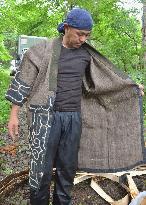
ASAHIKAWA, Japan - A man wears traditional formal attire of the indigenous Ainu people made from processed Lobed Elm bark in Toma, Hokkaido, on June 17, 2014.

  •  
Book on Hokkaido's indigenous Ainu people released in English

Book on Hokkaido's indigenous Ainu people released in English

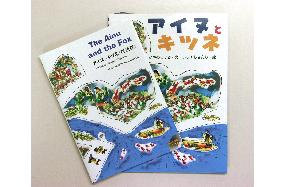
SAPPORO, Japan - The English-language version (left) of ''The Ainu and the Fox,' a picture book showing how Japan's indigenous Ainu minority sees the world will shortly go on sale overseas, the publisher said on May 1. The book, written by Ainu man Shigeru Kayano, 79, is based on an Ainu folktale and conveys Ainu beliefs about coexistence with nature.

  •  
Book on Hokkaido's indigenous Ainu people released in English

Book on Hokkaido's indigenous Ainu people released in English

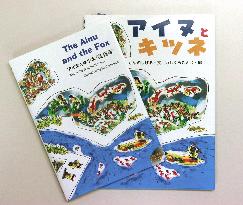
SAPPORO, Japan - The English-language version (left) of ''The Ainu and the Fox,' a picture book showing how Japan's indigenous Ainu minority sees the world will shortly go on sale overseas, the publisher said on May 1. The book, written by Ainu man Shigeru Kayano, 79, is based on an Ainu folktale and conveys Ainu beliefs about coexistence with nature. (Kyodo)

  •  
Ainu men

Ainu men

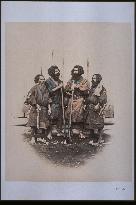
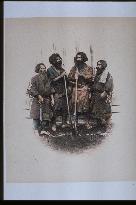
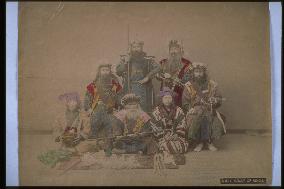
The two men in the middle are holding rifles. The second man from the right is wearing an apron with a knife (?). The man on the right is wearing earrings and carrying a knife sheath at his waist. The man on the left is probably holding a hatchet. (This is the same as photograph #3966).==Date:unknown, Place:Hokkaido, Photo:R. Stillfried, (Credit:Nagasaki University Library/Kyodo News Images) [Cabinet Number78‐81‐0]

  •  
An Ainu village

An Ainu village

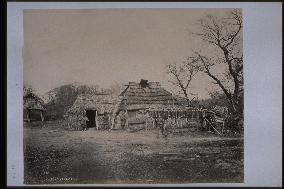
Ditch reeds and or cogon grasses were used in the walls and roofs of the cise houses. The maegoya cottage on the left is an annex to the omoya main house. The back of the main house was a sacred area with a shrine where inaw willow or dogwood wigs were offered on an altar. The device made from parallel cross logs in the foreground is a cage to rear infant bears. Poles to hang and dry fish are seen as well. This was adjacent to the Ainu warehouses depicted in photograph #3002.==Date:unknown, Place:Hokkaido, Photo:R. Stillfried, (Credit:Nagasaki University Library/Kyodo News Images) [Cabinet Number78‐50‐0]

  •  
Ainu men

Ainu men

The two men in the middle are holding rifles. The second man from the right is wearing an apron with a knife (?). The man on the right is wearing earrings and carrying a knife sheath at his waist. The man on the left is probably holding a hatchet. (This is the same as photograph #4063).==Date:unknown, Place:Hokkaido, Photo:R. Stillfried, (Credit:Nagasaki University Library/Kyodo News Images) [Cabinet Number77‐35‐0]

  •  
Ainu men

Ainu men

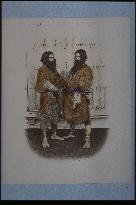
The clothing of the man on the left looks unnatural, especially the right elbow area (including designs). Later tinting may have caused this unnatural appearance. As for the man on the right as well, it is impossible to see what is hanging from his waist. They all wear gaiters. The wooden doors (wall) are the same as those in photograph #4064.==Date:unknown, Place:Hokkaido, Photo:R. Stillfried, (Credit:Nagasaki University Library/Kyodo News Images) [Cabinet Number76‐26‐0]

  •  
Ainu

Ainu

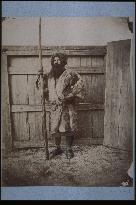
This is probably the man shown in the middle in photograph #3014. He is holding a long stick in his right hand and a short piece of stick in the left hand. The purpose of these sticks is not known.==Date:unknown, Place:Hokkaido, Photo:R. Stillfried, (Credit:Nagasaki University Library/Kyodo News Images) [Cabinet Number76‐25‐0]

  •  
Ainu men

Ainu men

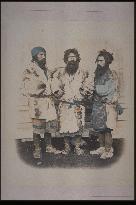
The two men on the left are wearing fur coats over cotton garments and straw sandals. The man on the right has a fur on his back. All the men are wearing gaiters. The man in the middle (the same man as in photograph #3910) has a sheath for a knife and a tobacco container hanging at his waist.==Date:unknown, Place:Hokkaido, Photo:unknown, (Credit:Nagasaki University Library/Kyodo News Images) [Cabinet Number60‐9‐0]

  •  
Life of Ainu

Life of Ainu

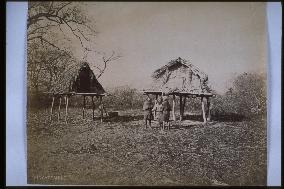
The English title at the lower left reads Ainu-TEMPLE., but this hut was not a religious facility but an elevated pu floor in which foods and provisions were stored. It is interesting that the upper parts of these two pu have a different structure. These probably stood adjacent to those in photograph #4032.==Date:unknown, Place:Hokkaido, Photo:unknown, (Credit:Nagasaki University Library/Kyodo News Images) [Cabinet Number60‐4‐0]

  •  
Ainu people

Ainu people

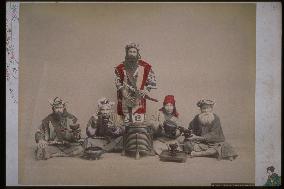
Men are wearing the crowns used in religious rituals. The man standing in the centre is wearing a war coat over a cotton garment and a sword in a shoulder belt. The sitting men are holding a set of ikupasuy utensils on top of a lacquerware bowl, all indispensable to Ainu rituals. The woman is pouring the sake.==Date:unknown, Place:Hokkaido, Photo:unknown, (Credit:Nagasaki University Library/Kyodo News Images) [Cabinet Number60‐3‐0]

  •  
An Ainu riding a horse

An Ainu riding a horse

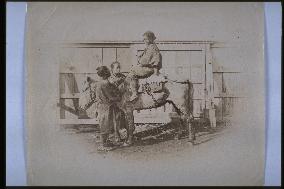
Two Japanese men are shown with an Ainu woman riding a horse. The ancestors of this horse were brought to Hokkaido from northern Japan and crossbred and developed during the Edo Period.==Date:unknown, Place:Hokkaido, Photo:unknown, (Credit:Nagasaki University Library/Kyodo News Images) [Cabinet Number60‐2‐0]

  •  
Ainu people

Ainu people

These people are the same as those in photograph #3000. The three men, from the right, are holding the bows and flower arrows used in the iyomante ritual offered in tribute to the bear. Both women are wearing a cloth (ciepanup) tied over the head and a necklace with disks. In the foreground, religious twigs (inaw) are displayed.==Date:unknown, Place:Hokkaido, Photo:unknown, (Credit:Nagasaki University Library/Kyodo News Images) [Cabinet Number60‐1‐0]

  •  
A view of the coast at Otaru

A view of the coast at Otaru

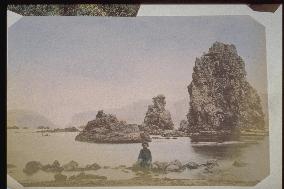
The first volume of History of Otaru City (published in 1958) carried this photograph along with the caption: Ainu people in the area of Tateiwa around 1874.==Date:unknown, Place:Otaru, Photo:unknown, (Credit:Nagasaki University Library/Kyodo News Images) [Cabinet Number51‐45‐0]

  •  
Ainu old people

Ainu old people

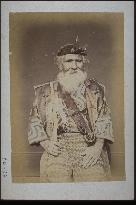
A man is wearing a ritual crown with an image on the front edge. He is wearing a costume with embroidered designs on the appliqu?. He is also wearing a war coat and holding a sacred wooden stick in his right hand. These are probably the same as the objects in photograph #2368). He is carrying a ritual sword called an emus. This photograph portrays the clothes used in Ainu rituals.==Date:unknown, Place:unknown, Photo:unknown, (Credit:Nagasaki University Library/Kyodo News Images) [Cabinet Number50‐34‐0]

  •  
Ainu

Ainu

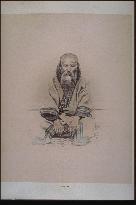
The book entitled Ainu People in the Ezo of Japan (published in 1892 by R. Hitchcock) carried this photograph with the caption An Ainu man in Tsuishikari. In 1875, 841 Sakhalin-Ainu people from the southern area of Sakhalin Island were forced to move to Wakkanai and, the following year, to Tsuishikari near Sapporo. The man's clothing is made from tree or plant bark.==Date:unknown, Place:Hokkaido, Photo:unknown, (Credit:Nagasaki University Library/Kyodo News Images) [Cabinet Number47‐50‐0]

  • Main
  • Top
  • Editorial
  • Creative
  • About Us
  • About ILG
  • Terms of use
  • Company
  • BEHIND
  • Price List
  • Single Plan
  • Monthly Plan
  • Services
  • Shooting
  • Rights Clearance
  • Support
  • FAQ
  • How To Buy
  • Contact Us
  • Become a Partner

© KYODO NEWS IMAGES INC

All Rights Reserved.

  • Editorial
  • Olympics
  • News
  • Sports
  • Japan
  • Tech
  • Royal
  • Disaster
  • NorthKorea
  • Old Japan
  • SNS
  • Creative
  • Food
  • Japan
  • Landscape
  • Animal
  • Popular
  • #Ukraine
  • #China
  • #coronavirus
  • #N. Korea
  • #Russia
  • #Thailand
  • #Ukraine
  • #China
  • #coronavirus
  • #N. Korea
  • #Russia
  • #Thailand
  • Food
  • Japan
  • Landscape
  • Animal
  • Olympics
  • News
  • Sports
  • Japan
  • Tech
  • Royal
  • Disaster
  • NorthKorea
  • Old Japan
  • SNS